The electric mobility landscape is increasingly defined by how much raw, unfiltered power a builder can safely harness. For years, independent garage builders, custom electric go-kart enthusiasts, and micro-mobility fleet startups have wrestled with a frustrating hardware gap: the massive chasm between underpowered entry-level hub motors that stall on hills, and prohibitively expensive, overly complex professional racing powertrains. Kunray has aggressively positioned its 48V-72V, 2000W-3000W Brushless Motor Kit precisely within this volatile void. To fully understand the underlying physics, the inevitable mechanical trade-offs, and the sheer engineering hostility of managing nearly 5800 RPMs in a custom chassis without catastrophic failure, we sat down with David Lin, Head of Powertrain Engineering at Kunray.
David Lin, Many DIY builders start with 500W or 1000W hub motors, only to realize they completely lack the punch for steep inclines or heavy-duty dirt tracks.When engineering this 2000W-3000W brushless series, what was the exact frustration point you wanted to eliminate for these creators?
David Lin: The absolute frustration point occurs the moment a builder takes their project to a fifteen-degree incline, or tries to accelerate out of a muddy corner, and the system simply bogs down. The motor groans, momentum dies, and you can practically smell the copper heating up. We wanted to entirely eliminate that mechanical hesitation. Building a true 3000W system wasn't just about hitting a higher top speed on a flat road; it was about delivering unapologetic, sustained torque. When a rider aggressively snaps the throttle, they need an immediate, violent response that can push a heavy metal chassis through rugged terrain without the motor choking.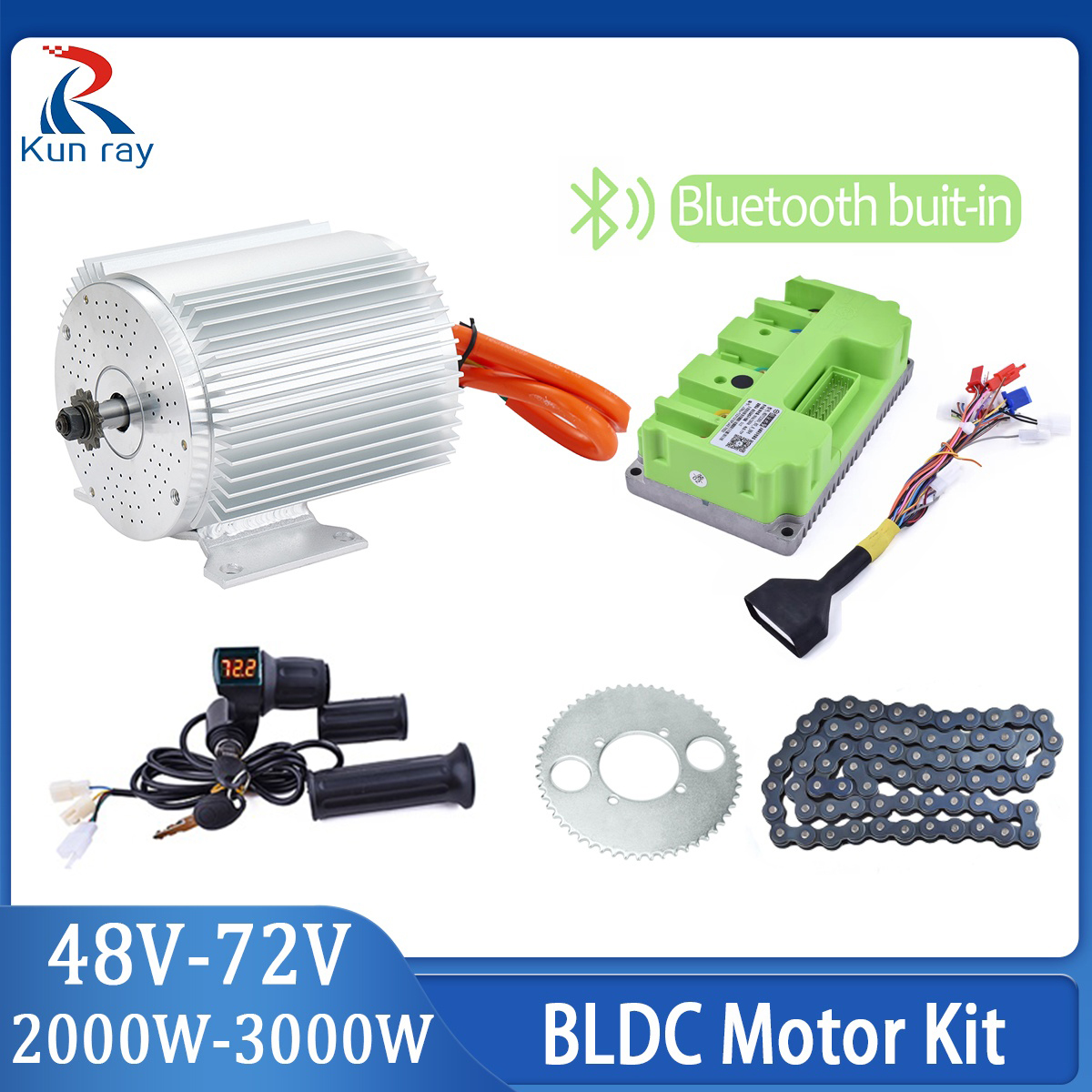
Let’s talk about the voltage dilemma. You support configurations ranging from 48V to 72V. For a builder trying to hit that 3000W peak, what is the harsh engineering reality about heat and current that they often overlook when choosing their setup?
David Lin: The underlying math is brutal and unavoidable, yet it is the number one physical reality amateur builders overlook. Power equals voltage multiplied by current. If you force 3000 watts of output from a standard 48V battery system, you are demanding the controller and motor handle over 60 amps of continuous electrical current. That extreme amperage generates immense parasitic heat in the phase wires and internal components. By designing this architecture to support a 72V ecosystem, we drastically lower the required amperage to achieve that same 3000W output—dropping it closer to 41 amps. This higher voltage approach drastically expands the system's thermal ceiling, preventing the copper windings from baking themselves during extended heavy-duty use.
Hitting up to 5800 RPM is a massive thermal and mechanical challenge. In an extreme scenario—say, a custom electric go-kart being pushed to its limits on a summer weekend—how does your specific brushless architecture prevent the system from literally melting down?
David Lin: Spinning a heavy rotor at 5800 RPM is fundamentally a hostile environment. If you take a custom kart onto an asphalt track in July and run it at full throttle, internal temperatures will spike aggressively. A traditional brushed motor would physically destroy itself through pure internal friction. Our brushless architecture survives precisely because we eliminate that mechanical contact. Heat generation is isolated primarily to the stator coils, which are tightly bonded to the thick aluminum outer casing acting as a massive passive heatsink. Furthermore, we utilize highly resilient neodymium magnets securely bound to the rotor, withstanding extreme centrifugal forces without ever compromising the vital magnetic flux.
From a pure manufacturing cost perspective, brushed motors are significantly cheaper. Why did Kunray completely abandon them for this high-speed lineup, essentially forcing the user into a more complex brushless controller ecosystem?
David Lin: Yes, from a pure Bill of Materials standpoint, a standard brushed motor and a rudimentary two-wire controller cost a fraction of our brushless kit. But that initial upfront savings is a dangerous commercial illusion. We forced the complete transition to a more complex, sensor-driven brushless ecosystem because the long-term return on investment absolutely demands it. Brushed motors require constant, messy maintenance; carbon brushes wear down rapidly, commutators burn out under strain, and power efficiency plummets significantly. We are essentially saying that we would much rather our users face a slightly steeper learning curve when initially wiring the three-phase lines, than have them rip their entire drivetrain apart six months later to replace melted components.
I noticed the inclusion of the T8F sprocket. For a 3000W output, why opt for this mid-drive mechanical transmission system rather than the increasingly popular direct hub-drive? What dynamic advantage does this give the rider?
David Lin: Direct hub motors are fantastic for simple urban commuting, but they operate on a highly restrictive, fixed gear ratio. By utilizing a mid-drive architecture paired directly with a heavy-duty T8F sprocket, we hand mechanical leverage right back to the builder. If a startup builds an off-road utility vehicle, they can pair our sprocket with a massive rear gear to multiply torque exponentially. Conversely, a tarmac-focused drag motorcycle can run a smaller rear sprocket for maximum top speed. The chain-drive system provides dynamic flexibility to absorb the vicious snap-torque of a 3000W launch through mechanical reduction, rather than punishing the motor's internal magnets.
One of the biggest nightmares for any garage builder is the mismatched controller scenario. How much hidden trial-and-error cost does this pre-matched controller kit actually save the end user?
David Lin: Mismatched electrical components are the graveyard of custom electric builds. If you connect a premium motor to a cheap, under-specced controller, you don't have a reliable powertrain—you have a ticking time bomb. It will either bottleneck your RPMs or fail catastrophically, sending a lethal voltage spike into the motor. By delivering a pre-matched, plug-and-play ecosystem with the motor, calibrated controller, and throttle interface, we absorb that hidden trial-and-error cost. Consumers don't have to spend weeks on internet forums diagnosing blown components or deciphering wiring diagrams. They wire it up, and it performs exactly as tested.
When local micro-mobility startups or custom kart fleets look at this powertrain, they care obsessively about downtime. How does the maintenance lifecycle of this electric kit compare to a traditional gas-powered equivalent of similar output?
David Lin: For commercial operators, such as local go-kart tracks or rental fleets, operational downtime is the ultimate enemy of profitability. A traditional 50cc or 100cc gas-powered engine of similar output requires an exhausting, never-ending maintenance lifecycle. You are constantly dealing with daily oil level checks, replacing fouled spark plugs, tuning sensitive carburetors, and frequently replacing centrifugal clutches that burn out from abuse. The maintenance lifecycle of our 3000W electric kit effectively drops to zero on the powertrain side. There are absolutely no fluids to leak, no filters to clog, and no violent idling vibrations tearing the welded chassis apart. The fleet manager’s role permanently shifts from turning wrenches on greasy engines to simply ensuring battery packs are charged.
If you could stand behind a builder right as they unbox this kit in their garage, what is the single most critical mistake you hope they avoid during the wiring and initial testing phase?
David Lin: If I were standing right there in their garage, the one thing I would passionately warn them about is rushing the initial Hall sensor and phase wire testing sequence. Builders get so incredibly excited to see the rear wheel spin that they will blindly connect the heavy phase wires, completely ignore the delicate Hall sensor orientation, and instantly pin the throttle to maximum. If the controller mapping is slightly off, flooding the system with 72 volts will instantly fry the controller board. I always tell them: safely suspend the drive wheel off the ground, use the absolute lowest possible throttle input for the very first rotation test, and just listen. A properly wired brushless system should hum effortlessly, not shudder or grind.
As the conversation went on, it became abundantly clear that Kunray’s approach to high-output motors is fundamentally rooted in system-level thinking rather than isolated component design. By treating the motor, the calibrated controller, and the transmission sprocket as an inseparable ecosystem, they meticulously enforce a design logic that naturally mitigates installation errors.
The micro-mobility industry’s ongoing transition from internal combustion to electric propulsion is largely driven by accessibility, but raw, unfiltered power has historically been gatekept by extreme engineering complexity. Kunray’s 3000W brushless architecture serves as a definitive case study in how to democratize extreme mechanical capability without sacrificing operational integrity. By systematically neutralizing the hidden financial costs of component mismatch and aggressively expanding the physical limits of thermal management, they have successfully transformed a volatile science project into a highly reliable commercial asset. Ultimately, true engineering value in this space is measured not simply by the wattage numbers printed on a specification sheet, but by the relentless, predictable consistency with which that violent power can be safely unleashed on the tarmac.


