The Kunray MY1030 mid-drive BLDC motor is designed to give builders more flexibility when selecting a motor. With seven main configurations ranging from 36V 1000W to 72V 3000W, the MY1030 platform covers a wide range of light electric vehicle and DIY conversion applications.
So, how do you choose the right MY1030?
This guide explains the main factors to consider before ordering.
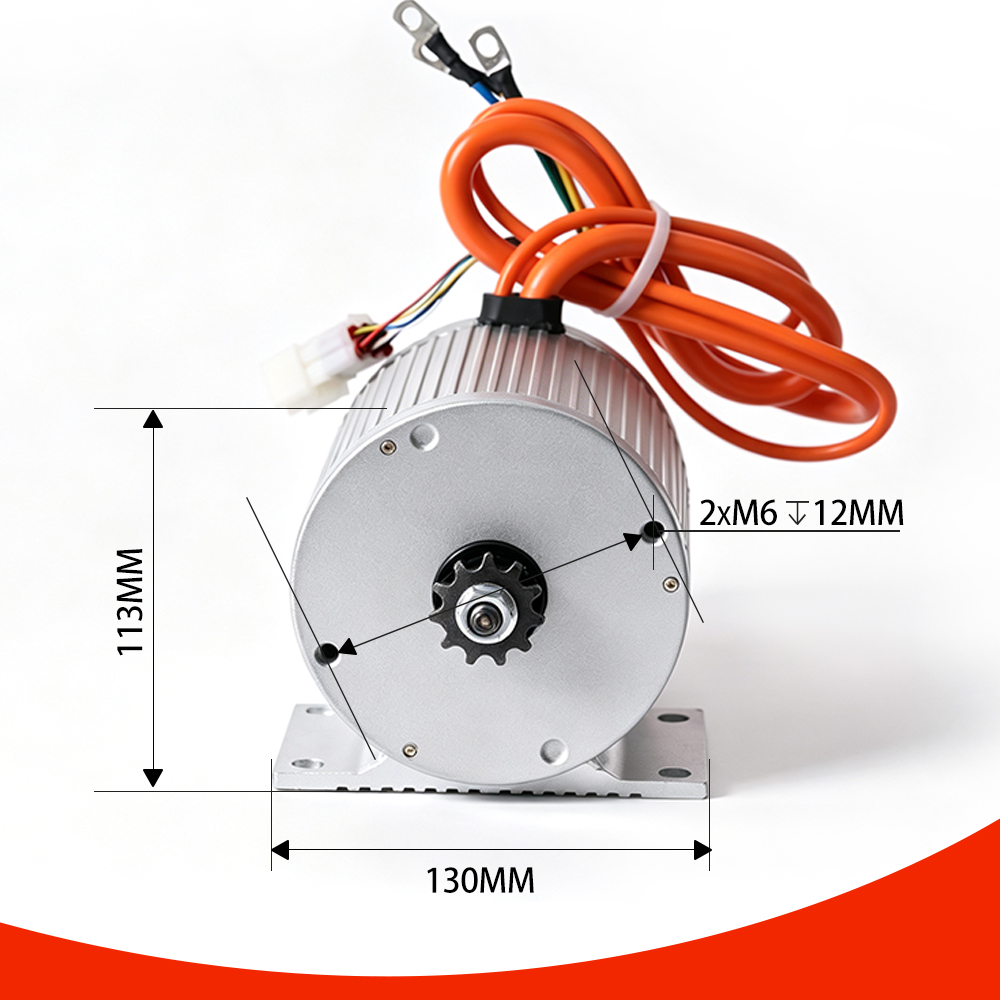
The MY1030 is currently available in seven main voltage and power configurations.
| Version | Rated Power | Peak Power | Rated Current | Rated Torque | Peak Torque | Rated Speed |
|---|---|---|---|---|---|---|
| 36V 1000W | 1000W | 1500W | 28A | 3.2 N·m | 6 N·m | 3000 RPM |
| 48V 1000W | 1000W | 1500W | 20.8A | 3.2 N·m | 6 N·m | 3000 RPM |
| 48V 1600W | 1600W | 2500W | 33A | 4 N·m | 8.5 N·m | 3500 RPM |
| 48V 2000W | 2000W | 2800W | 42A | 5.4 N·m | 10 N·m | 4000 RPM |
| 60V 2000W | 2000W | 2800W | 33A | 5.4 N·m | 10 N·m | 4000 RPM |
| 60V 2500W | 2500W | 3000W | 42A | 6.2 N·m | 11 N·m | 4000 RPM |
| 72V 3000W | 3000W | 4000W | 55A | 6.8 N·m | 13.5 N·m | 4500 RPM |
The first step is to determine which voltage your vehicle's electrical system is designed to use.
Voltage is one of the first specifications you should check.
The MY1030 range includes:
A motor should be selected according to the voltage of the vehicle's battery and electrical system.
For example, if your project uses a 48V system, you should look at the 48V MY1030 versions rather than simply choosing a higher-power 60V or 72V motor.
The available 48V options include:
This gives builders several power levels while keeping the same nominal system voltage.
The motor, battery, controller, and other electrical components form one complete system.
Changing the motor voltage is therefore not simply a matter of replacing one component. The complete electrical configuration should be checked before installation.
For this reason, do not select a motor based on wattage alone.
After determining the voltage, the next question is:
How much motor power does your project need?
The MY1030 covers a relatively wide power range.
The 1000W versions are suitable for lighter electric vehicle projects and entry-level conversions.
Depending on the complete vehicle configuration, they can be considered for applications such as:
The 36V and 48V versions both offer 1000W rated power.
The 48V 1600W MY1030 provides:
It can be considered when a 1000W motor is not enough for the intended application and the vehicle is designed around a 48V system.
The MY1030 offers both 48V 2000W and 60V 2000W configurations.
Both versions have:
The key difference is the system voltage.
This makes the two versions useful for different vehicle electrical configurations.
Potential applications include:
The 60V 2500W version provides:
It can be considered for projects requiring more power than the 2000W versions while using a 60V electrical system.
For projects requiring the highest rated power in the current MY1030 range, the 72V 3000W version provides:
It is positioned for higher-performance applications such as electric motorcycles, heavier conversion projects, and racing-oriented applications.
However, a 3000W motor does not automatically mean that the vehicle will reach a specific speed.
Actual vehicle performance depends on the complete system, including:
A common mistake when selecting an electric motor is to look only at the wattage.
Motor speed and torque are also important.
For example, the MY1030 versions have different rated speeds:
The drivetrain then determines how this motor speed is converted into vehicle wheel speed and wheel torque.
This is where the sprocket becomes important.
The MY1030 supports five official sprocket configurations:
| Sprocket | Teeth | Chain | Shaft Type |
|---|---|---|---|
| 25H | 11T | #25 | A |
| T8F | 11T | T8F | A |
| #35 | 9T | #35 | B |
| #35 | 11T | #35 | B |
| 420 | 8T | 420 | B |
The most important rule is simple:
The sprocket must match the chain used by your vehicle.
The chain specification should therefore be confirmed before ordering the motor.
If your project uses a #35 chain, MY1030 offers both 9T and 11T options.
In general drivetrain terms:
A smaller motor sprocket provides greater mechanical reduction and stronger torque multiplication at the wheel.
A larger motor sprocket provides a higher potential wheel speed but less mechanical torque multiplication.
Therefore, the choice between 9T and 11T should be based on the overall drivetrain and the performance characteristics you want from the vehicle.
The motor itself should not be evaluated separately from the gearing system.
Another important question is:
Can the MY1030 physically fit your vehicle?
The MY1030 is available with or without a mounting bracket.
This version may be suitable for vehicles that already have compatible motor mounting points.
It can also be useful for custom frames and OEM applications where the mounting structure is designed separately.
The bracket version is designed for applications where the motor needs to be secured using a bottom mounting bracket.
For DIY conversion projects, this can make installation easier when the original vehicle frame does not have suitable mounting points.
Before ordering, check:
Correct mechanical alignment is essential for reliable drivetrain operation.
The motor is only one part of the electrical system.
The controller also needs to be compatible with the selected MY1030 configuration.
The MY1030 uses Hall sensor signals, and the controller should support the motor's Hall signal system.
For example, if you select a 72V 3000W motor, you should not assume that any 72V controller will automatically be suitable.
The controller selection should take into account the motor's:
If you want to use the MY1030's built-in temperature sensor, the controller should also provide the appropriate temperature sensor input and protection function.
One of the important features of the MY1030 platform is that KTY83-122 temperature sensing is standard across the range.
This is particularly useful for applications where the motor may experience prolonged or heavy loads.
The temperature sensor provides motor temperature feedback to a compatible controller.
However, the presence of a temperature sensor does not mean that the motor can be operated indefinitely at maximum load.
The MY1030 uses natural air cooling and is classified for S9 duty. Installation should therefore provide adequate airflow, and users should avoid treating the peak power rating as a continuous operating rating.
The MY1030 uses an aluminum housing with integrated cooling fins and has an IP54 protection rating.
This makes the motor suitable for many outdoor electric vehicle applications.
However, IP54 does not mean waterproof.
The motor should not be:
For off-road vehicles, proper installation and protection of the complete electrical system remain important.
Here is a simplified starting point for choosing a MY1030 configuration:
| Application Type | Possible MY1030 Options |
|---|---|
| Lightweight electric scooter | 36V/48V 1000W |
| Small electric go-kart | 36V/48V 1000W |
| Razor MX500-type project | 36V/48V 1000W |
| Medium DIY conversion | 48V 1600W / 2000W |
| Razor MX650-type project | 48V 1600W / 2000W |
| Drift trike | 48V 1600W / 2000W |
| Lightweight ATV | 60V 2000W / 2500W |
| Adult electric go-kart | 60V 2000W / 2500W |
| Mini electric motorcycle | 60V 2000W / 2500W |
| Higher-performance electric motorcycle | 72V 3000W |
| Heavy-duty / racing-oriented project | 72V 3000W |
These are starting points rather than guaranteed vehicle configurations.
The final motor selection should always be confirmed against the actual battery, controller, drivetrain, vehicle weight, mounting structure, and intended use.
Before placing an order, it is useful to collect the following information about your vehicle:
Having this information ready makes motor selection much easier.
Suppose you are building a 48V electric vehicle and are deciding between the MY1030 48V 1600W and 48V 2000W.
The 48V 1600W version provides:
The 48V 2000W version provides:
If the vehicle is relatively light and the required performance is moderate, the 1600W version may be worth considering.
If the vehicle requires a higher rated power level and the rest of the electrical and mechanical system is designed accordingly, the 2000W version may be a better starting point.
The important point is that more power is not automatically better.
The motor should match the entire vehicle system.
One of the biggest advantages of the MY1030 platform is the range of available configurations.
Instead of offering only one motor specification, the platform provides different voltage and power options for different projects.
At the same time, the motor includes several features designed for practical installation and maintenance:
This combination makes the MY1030 suitable for a wide range of electric vehicle conversion projects.
When choosing a motor for a DIY electric vehicle, it is tempting to start with the highest wattage available.
A better approach is to start with the complete vehicle system.
First determine your battery voltage.
Then consider the required power level.
After that, check the controller, Hall sensor compatibility, temperature sensor support, sprocket and chain, mounting dimensions, and drivetrain configuration.
For the MY1030, the available options range from 36V 1000W to 72V 3000W, giving builders multiple starting points for different types of electric vehicles.
The right choice is not necessarily the most powerful motor.
The right choice is the MY1030 configuration that matches your vehicle, electrical system, drivetrain, and intended application.
If you are unsure which MY1030 version is suitable for your project, prepare the following information:
Vehicle Model + Battery Voltage + Controller + Chain Type + Intended Application
With these details, you can narrow down the motor, sprocket, and mounting configuration before placing an order.


