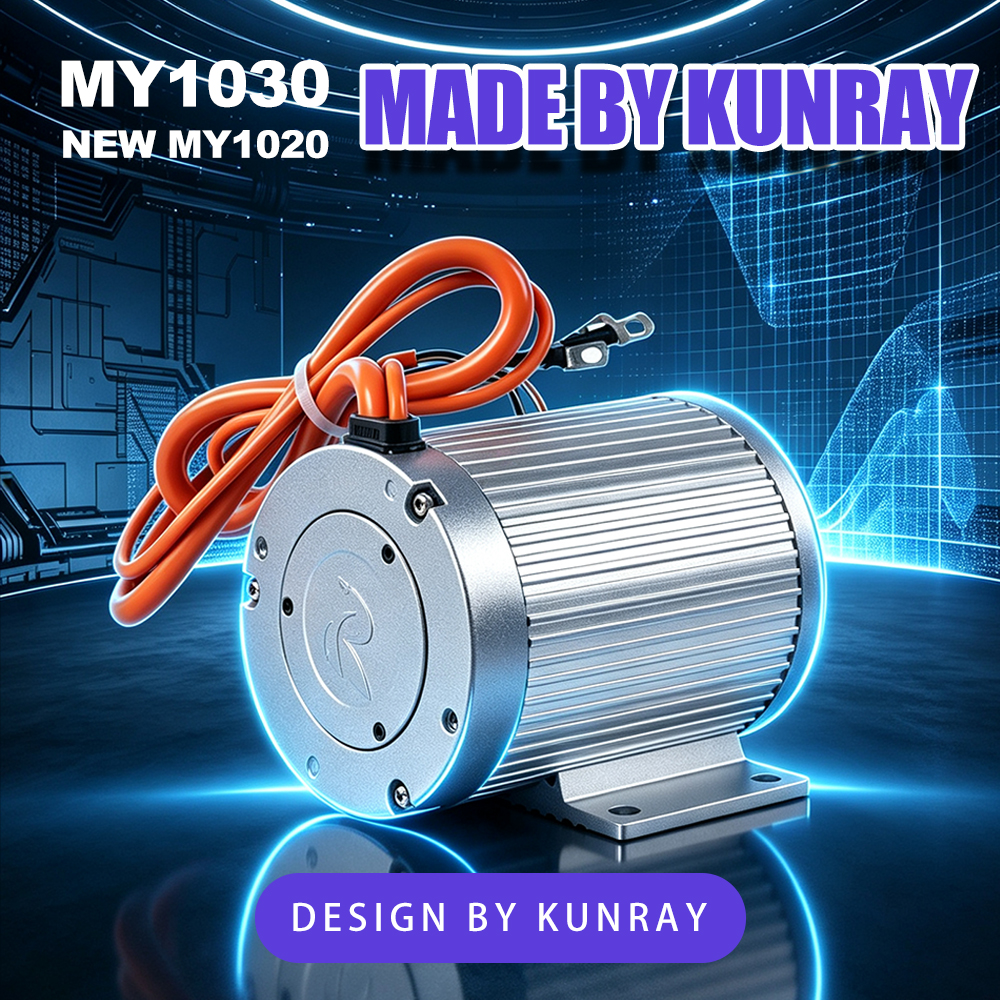
Can the motor continuously produce 4000W?
Can a 3000W motor temporarily produce more?
Why does the peak rating matter if the motor is called a 3000W motor?
To understand these questions, it is necessary to look beyond the headline wattage and consider motor temperature, duty cycle, current, speed, load, and operating conditions.
The Kunray MY1030 provides a useful example because its different configurations specify both rated and peak power.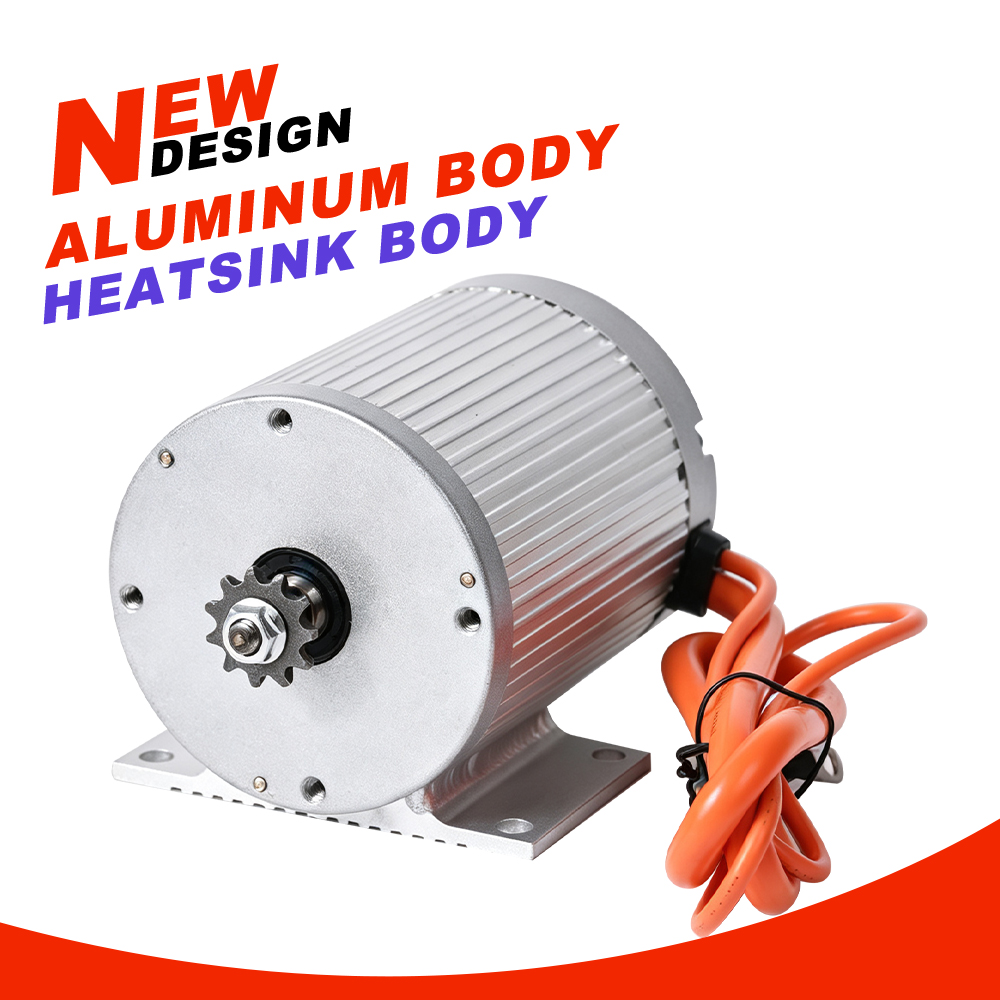
Rated power is best understood as a reference operating capability under defined conditions.
It provides a practical basis for selecting a motor for an application.
For example, the MY1030 range includes:
The rated power is the number that should generally be used when comparing the motor's intended power class.
It should not be confused with the maximum instantaneous output the motor may reach.
Peak power describes a higher output level that can be reached under appropriate conditions for a limited period or operating condition.
For example, the 72V 3000W MY1030 is specified as:
3000W rated power
and:
4000W peak power
The difference between these two values is important.
The 4000W figure does not mean that the motor should be treated as a continuously operating 4000W motor.
Instead, it indicates that the motor system can reach a higher output level under appropriate conditions.
The main reason is heat.
When an electric motor operates, part of the electrical energy becomes mechanical output.
Another part becomes heat.
At higher current and higher load, internal losses increase.
The motor must then dissipate that heat.
If heat generation exceeds heat dissipation for too long, motor temperature rises.
This is why continuous operation at a higher output level can create a thermal problem.
The important relationship is:
Higher Load → More Heat → Higher Temperature → Greater Thermal Stress
Therefore, peak power should always be understood together with operating time and thermal conditions.
The MY1030 manual specifies an S9 duty cycle, meaning a non-continuous duty cycle with varying load.
This is important because real electric vehicles rarely operate at one constant load.
A vehicle may:
The motor's load therefore changes over time.
S9 duty operation is designed around this kind of varying load rather than assuming one constant operating point.
Consider an electric vehicle starting from rest.
At this moment, the motor needs to generate substantial torque to accelerate the vehicle.
The system may temporarily demand higher electrical and mechanical output.
Once the vehicle reaches cruising speed, the required power may decrease.
This creates a natural difference between:
Short-duration high output
and
Long-duration continuous output
Peak power is particularly relevant to the first category.
Rated power is more relevant to understanding the motor's sustained power class.
Power does not exist independently of motor speed and torque.
A simplified relationship is:
Power ∝ Torque × RPM
Therefore, peak power can occur at a particular combination of torque and speed.
This is another reason why simply comparing wattage between two motors can be misleading.
A motor's performance depends on where in its operating range that power is produced.
For a vehicle builder, the important question is not only:
“How much peak power does the motor have?”
but also:
“At what operating conditions can the motor produce useful torque and power?”
The MY1030 uses an aluminum housing with integrated cooling fins and natural air cooling.
This design provides a heat-dissipation path from the motor housing to the surrounding air.
However, the actual thermal performance depends on the installation.
For example, a motor installed in open airflow may dissipate heat differently from an identical motor enclosed inside a compact frame.
Therefore, the same motor can experience different thermal conditions in different vehicles.
This is why motor ratings should never be separated completely from installation conditions.
The MY1030 includes a KTY83-122 temperature sensor across the range.
The purpose of this sensor is to provide motor temperature information to a compatible control system.
This becomes particularly valuable during high-load operation.
If the controller supports the appropriate temperature input and protection function, temperature information can be used to help prevent excessive thermal stress.
However, temperature sensing is not a substitute for correct motor selection or cooling.
It is part of a broader protection strategy.
Suppose two motors are available.
Motor A:
2000W rated / 2800W peak
Motor B:
2500W rated / 3000W peak
Motor B has the higher ratings.
But that does not automatically mean it is the better choice.
The correct motor depends on:
A motor that is properly matched to the vehicle may perform better and operate more reliably than a larger motor that is poorly matched to the system.
When evaluating a motor, don't stop at the wattage.
Look for:
This tells you the motor's general power class.
This indicates the higher output capability under appropriate conditions.
Useful for understanding the motor's normal operating torque capability.
Important for short-duration acceleration and high-load conditions.
Important for drivetrain and gear-ratio design.
Provides additional information about the motor's operating range.
Helps explain how the motor is intended to operate under changing loads.
Important for understanding thermal behavior.
Useful for monitoring and protection.
Looking at all of these specifications provides a much more complete picture than looking at the wattage alone.
The 72V 3000W MY1030 is specified at:
Notice that torque and speed also have rated and peak values.
This reinforces an important principle:
The motor has an operating range, not a single fixed performance point.
A complete vehicle system should therefore be designed around realistic operating conditions rather than the largest number on the specification sheet.
Instead of interpreting the specification as:
3000W motor = 4000W continuously available
think of it as:
3000W class motor with the ability to reach a higher peak output under appropriate conditions.
This distinction is important for:
Rated power and peak power answer different questions.
Rated power helps define the motor's normal power class.
Peak power describes a higher output capability under appropriate conditions.
Neither number should be considered independently from:
Torque + RPM + Duty Cycle + Cooling + Temperature + Controller + Battery + Vehicle Load
For electric vehicle builders, understanding this distinction helps prevent one of the most common mistakes in motor selection:
choosing a motor based only on its highest advertised wattage.
The better approach is to design around the motor's complete operating envelope.