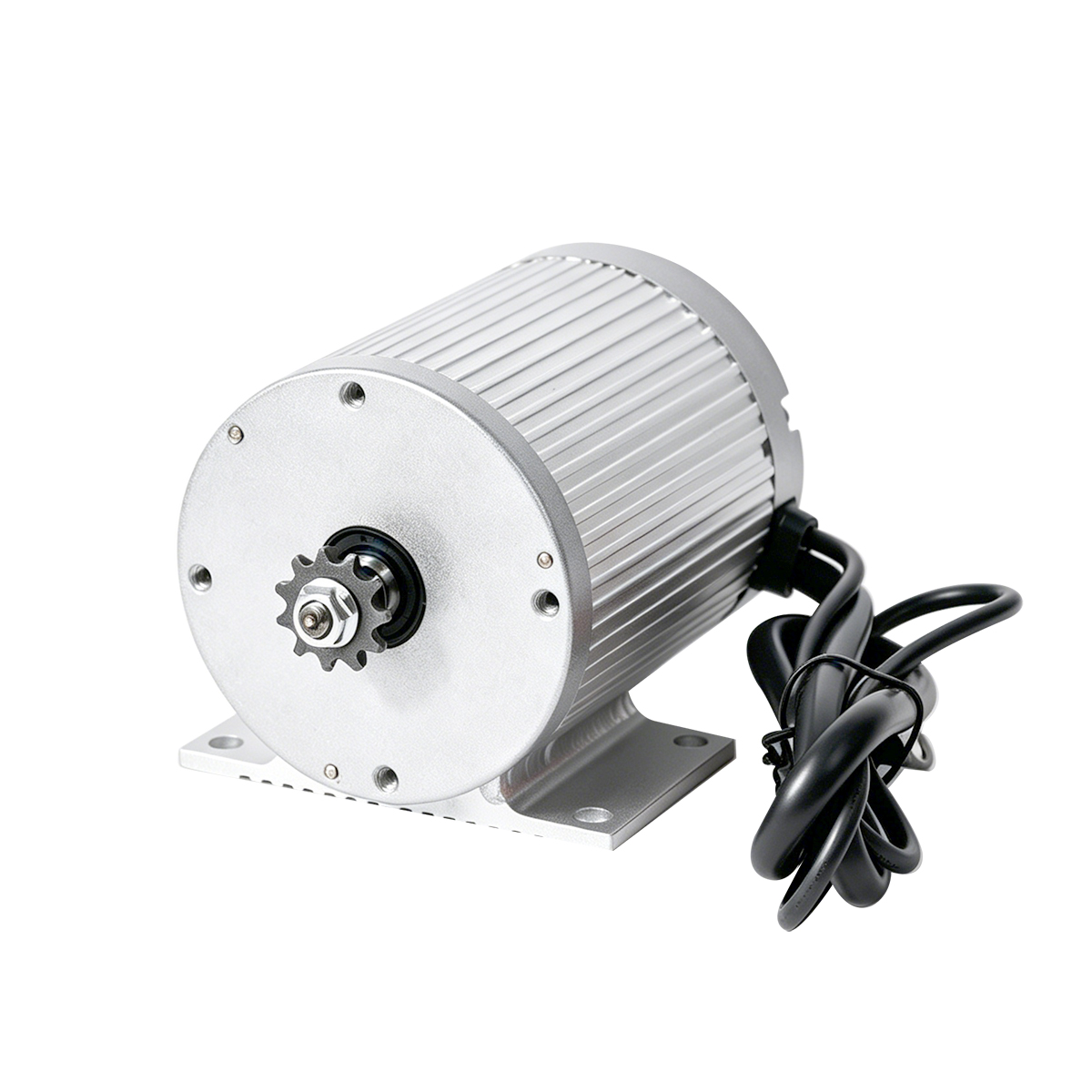
The answer involves much more than the motor itself.
Voltage affects the relationship between power, current, wiring, controller design, battery configuration, motor speed, and the overall electrical architecture of the vehicle.
The Kunray MY1030 platform provides configurations from 36V to 72V, including 48V, 60V, and 72V versions.
Understanding the engineering differences between these voltage levels can help builders choose the right system instead of simply choosing the highest number.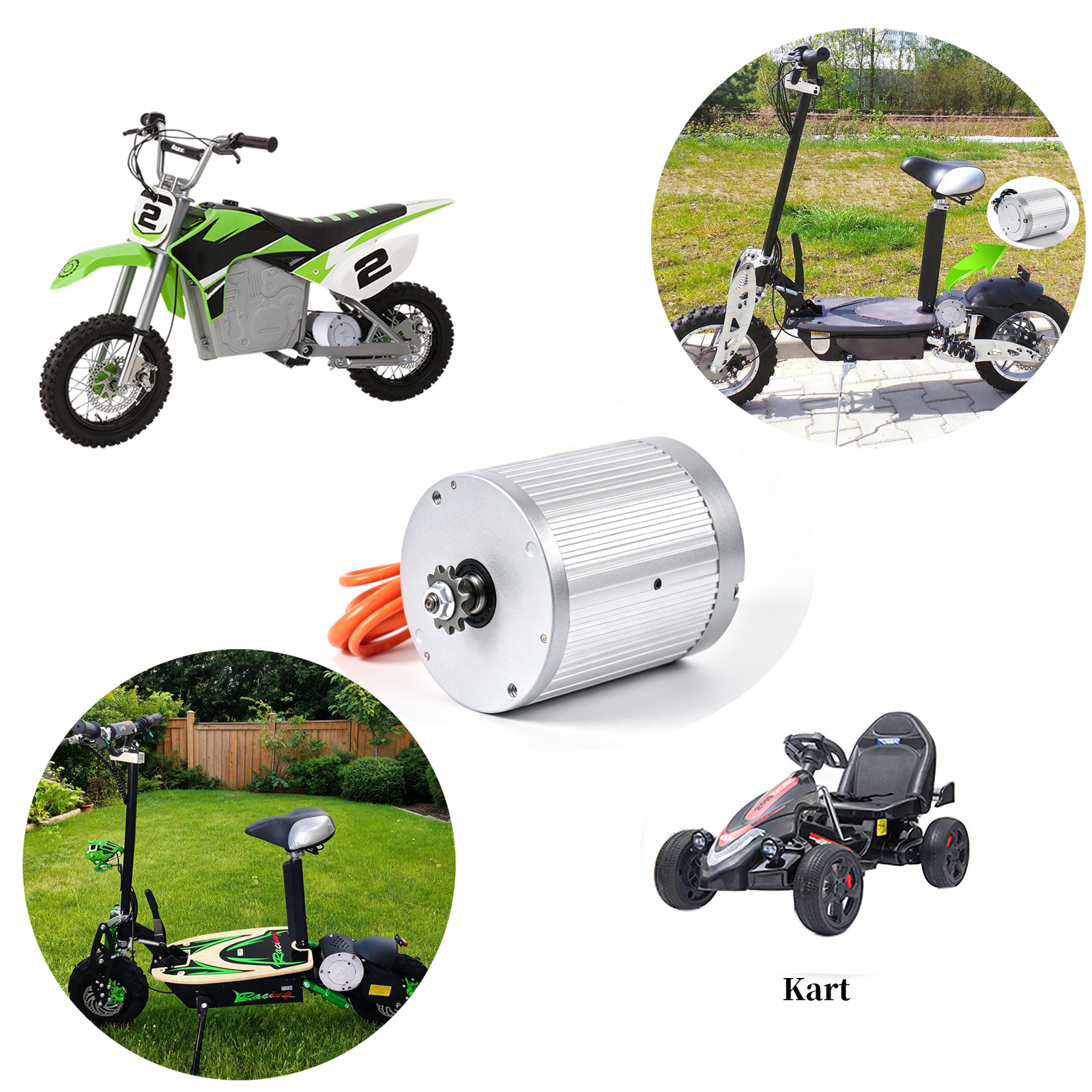
A simplified electrical relationship is:
Power = Voltage × Current
Therefore:
Current = Power ÷ Voltage
For a 2000W system, an idealized calculation gives:
2000 ÷ 48 ≈ 41.7A
2000 ÷ 60 ≈ 33.3A
2000 ÷ 72 ≈ 27.8A
These are simplified values and should not be treated as the exact current drawn by a real motor system.
Real current depends on motor efficiency, controller operation, load, operating speed, acceleration, battery voltage, and losses.
However, the relationship clearly shows why higher voltage can be useful for higher-power systems.
For the same power level, a higher system voltage generally means lower current.
Current has a direct relationship with resistive electrical losses.
A simplified relationship is:
Power Loss = I²R
where:
Because current is squared, reducing current can significantly reduce resistive losses when resistance remains comparable.
For example, reducing current by half reduces the theoretical I²R loss to one quarter.
This is one reason higher-voltage electrical systems become attractive as power requirements increase.
They can allow the same power to be transmitted with lower current.
This distinction is extremely important.
A 72V motor is not automatically more powerful than a 48V motor.
Power depends on both voltage and current.
For example:
48V × 40A ≈ 1600W
while:
72V × 22A ≈ 1584W
These systems operate at very different voltages but can be in a similar power range.
Therefore, voltage should be viewed as one variable within the complete power system.
The MY1030 platform includes:
The 48V 2000W and 60V 2000W versions are particularly useful for understanding this concept.
Both are rated at:
2000W
Both have:
5.4 N·m rated torque
and:
10 N·m peak torque
Both are rated at:
4000 RPM
Yet their electrical system voltages are different.
This demonstrates an important principle:
Voltage and rated power are related, but they are not interchangeable specifications.
When moving from a 48V system to a 60V or 72V system, the motor is only one component that changes.
The battery must match.
The controller must match.
The wiring and connectors must be appropriate.
Protection devices must be selected for the system.
Charging equipment must also be compatible.
This is why increasing voltage should be considered a system-level decision, not simply a motor upgrade.
A higher-voltage system generally requires a battery pack with a higher nominal voltage.
This changes the battery's electrical architecture.
The exact battery configuration depends on the cell chemistry and cell specifications, so a motor voltage label alone is not enough to determine the battery pack configuration.
The important rule is:
Battery voltage, controller voltage, and motor voltage must be designed as a compatible system.
Do not assume that a controller designed for one voltage platform can automatically be used on another.
The controller is the electrical bridge between the battery and the motor.
When the system voltage changes, the controller must also be suitable for the new voltage.
It must also be compatible with the motor's:
The MY1030 uses an externally serviceable Hall sensor and a KTY83-122 temperature sensor.
A controller that does not support the relevant sensor functions may not be able to take full advantage of these features.
The MY1030 specifications also distinguish phase-wire configurations.
The manual identifies:
The larger conductor size on the higher-voltage/high-power versions reflects the different electrical configuration of the platform.
However, cable selection for an entire vehicle cannot be determined from motor phase-wire size alone.
Battery cables, controller cables, connectors, fuses, switches, and other components must all be selected according to their actual current and voltage requirements.
Not automatically.
Vehicle speed is influenced by:
The MY1030 itself demonstrates that voltage and motor speed are separate specifications.
For example:
The 48V 2000W version is rated at 4000 RPM.
The 60V 2000W version is also rated at 4000 RPM.
Therefore, simply changing from 48V to 60V does not automatically mean the motor will turn 25% faster.
The actual motor operating point depends on the motor design and controller.
There are several engineering reasons.
As shown earlier:
I = P ÷ V
Higher voltage can reduce current for a given power level.
Because:
P_loss = I²R
Lower current can reduce resistive losses.
As system power increases, keeping current manageable becomes increasingly important.
This can influence:
Higher voltage is not simply "better."
It also requires greater attention to electrical safety and system design.
As voltage increases, components must be rated appropriately.
The system should consider:
This is especially important when moving into 60V and 72V platforms.
A useful way to think about voltage selection is:
Often practical for:
Can be useful for:
More appropriate for:
These are general engineering directions rather than universal rules.
The vehicle, battery, controller, and legal requirements all need to be considered.
Don't ask:
“Is 72V better than 48V?”
Ask:
“Which voltage allows my complete powertrain to operate efficiently and reliably?”
The correct voltage depends on the required power, battery architecture, controller, wiring, drivetrain, vehicle size, and intended application.
The MY1030 platform demonstrates this system-level approach by offering multiple voltage and power configurations rather than forcing every vehicle into one electrical architecture.
Increasing system voltage changes more than the motor.
It changes the electrical relationship between:
Power ↔ Current ↔ Wiring ↔ Controller ↔ Battery
For the same power, a higher voltage generally allows lower current, which can help manage resistive losses and electrical component requirements.
But higher voltage also requires appropriate batteries, controllers, wiring, connectors, protection, and charging equipment.
Therefore:
48V, 60V, and 72V are not simply three different motor labels. They represent different electrical system architectures.
Choosing the right one means designing the complete system around the vehicle's actual requirements.