If you've spent time in the DIY electric vehicle community — go-karts, e-bikes, dirt bikes, custom scooters — you've almost certainly come across the Kunray MY1020 motor. It's become a workhorse in the scene for good reason: brushless, mid-drive friendly, available in both 48V/2000W and 72V/3000W configurations, and now with a built-in KTY84-130 temperature sensor that actually talks to your controller.
But there's a question that comes up in every forum thread once builders start pushing serious wattage:
"My motor hits 140°F after 30 minutes of hard riding. Should I add a heat sink?"
This post breaks down exactly that — what the MY1020 heat sink does, who actually needs it, and whether it's worth buying the motor bundle vs. adding it later.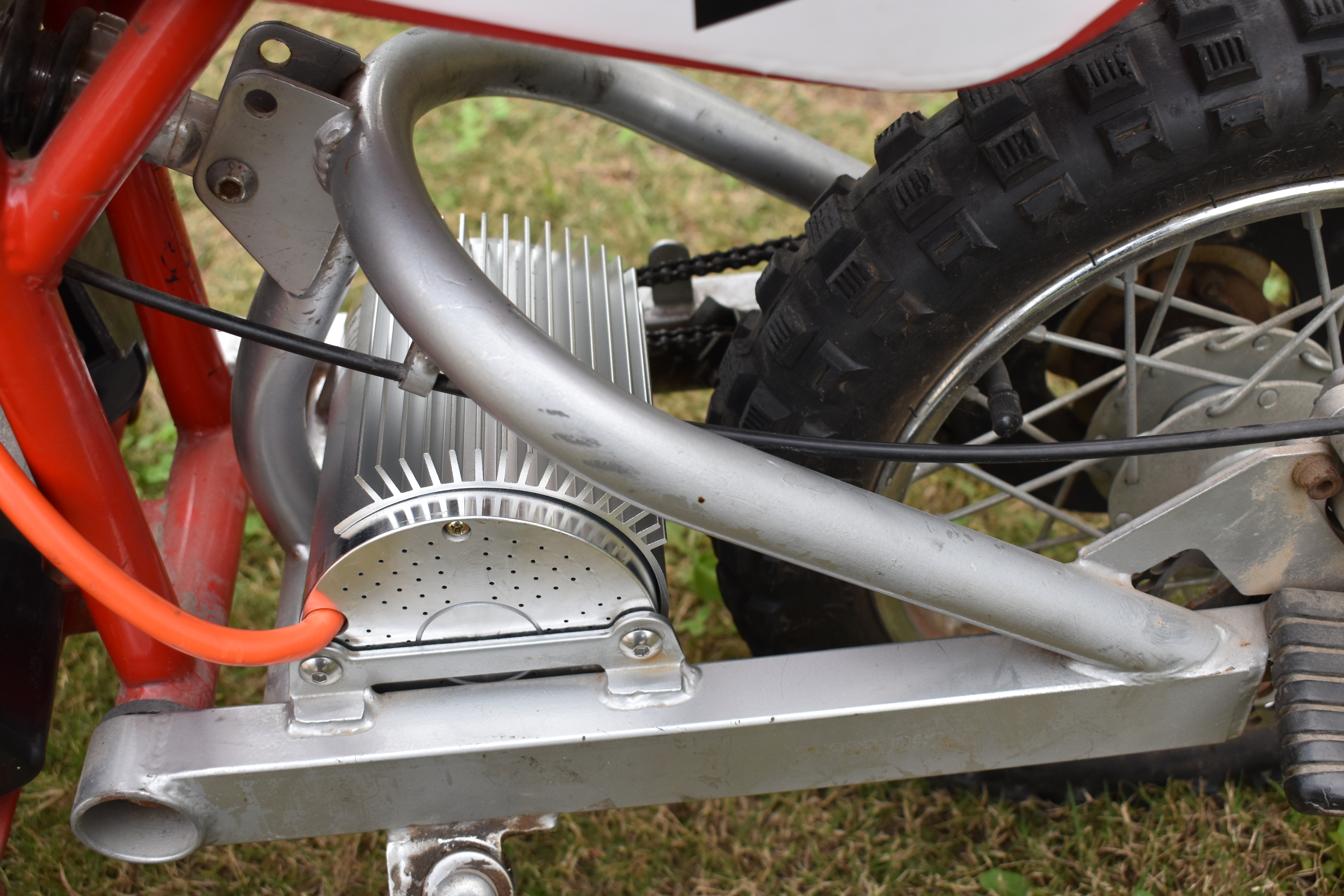
The MY1020 is a compact, high-torque motor. That power density is a feature — it's why it fits neatly on a Razor MX500/MX650 swing arm or into a custom go-kart chassis. But physics doesn't negotiate: small volume + high power = heat density.
During hard riding, copper windings generate I²R losses. At 72V with phase currents up to 260A (with the FarDriver NS12 controller), you can be pushing serious wattage through a motor that's roughly the size of a large coffee can.
The MY1020's built-in KTY84-130 silicon temperature sensor is your early warning system. It monitors winding temperature in real time and reports back to the FarDriver controller, which will throttle output or cut power at a set threshold (typically ~105°C / 221°F for safe winding protection).
The problem: by the time your controller hits the protection threshold, your windings have already been running hot for a while. Repeated thermal cycling accelerates insulation degradation. Long-term, it shortens motor life.
The heat sink is the passive solution to this problem.
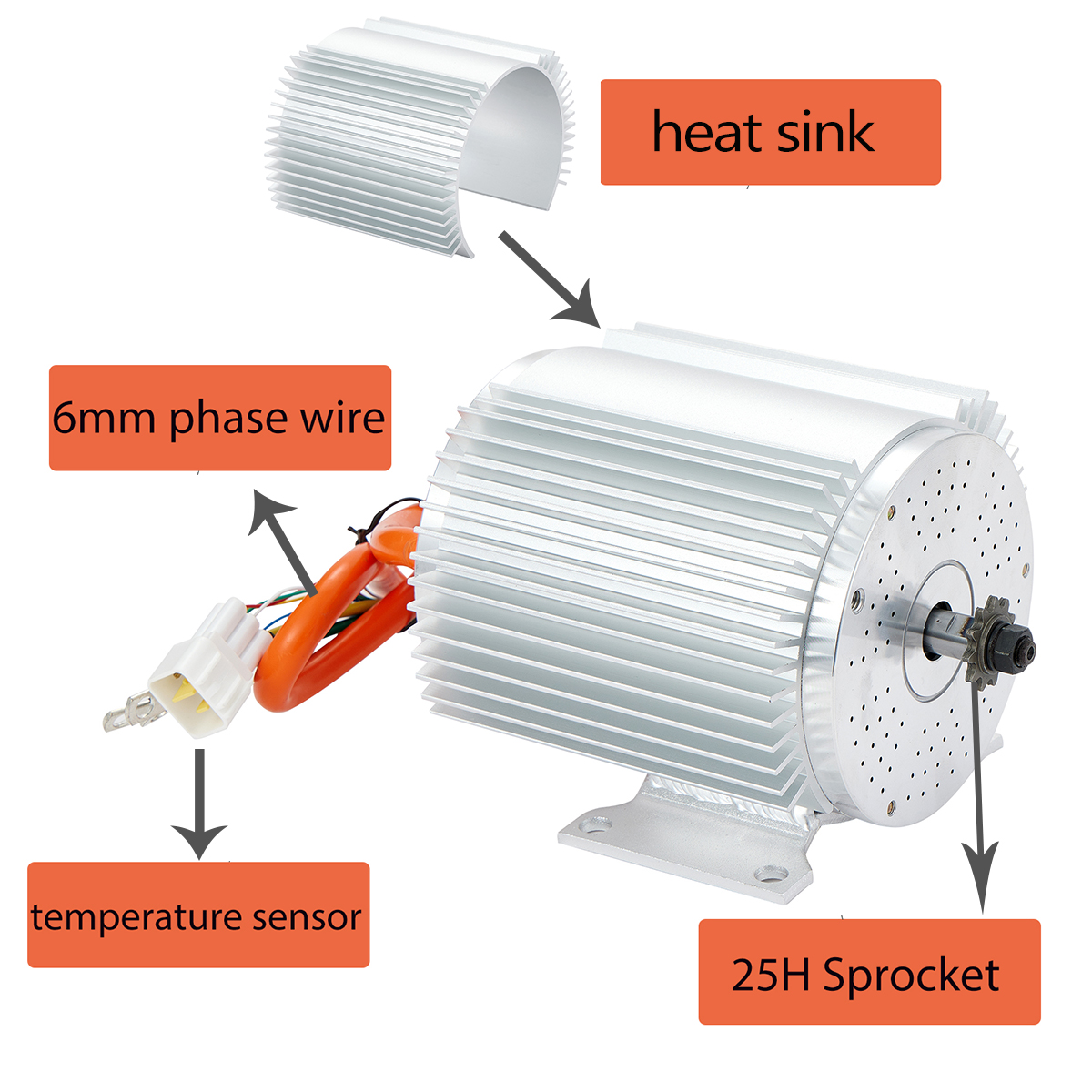
The Kunray aluminum alloy heat sink is a bolt-on cooling fin assembly machined from high-conductivity aluminum. It wraps around the motor body and dramatically increases the surface area available for convective heat dissipation.
Here's the physics in plain terms:
Without heat sink:
  Heat path: Windings → Steel stator → Motor housing (small surface) → Air

With heat sink:
  Heat path: Windings → Steel stator → Motor housing → Aluminum fins (large surface) → Air
  ↑ Surface area increases ~3-4× → Heat leaves faster
Real-world result: Community builders report the motor staying around 140°F (60°C) peak vs. reaching that same temperature in just 10-15 minutes of aggressive riding without the sink. That's the difference between a motor that throttles back and one that keeps pulling.
Be honest with yourself before you spend the money. The heat sink is a genuine upgrade for some builds and unnecessary overhead for others.
Kunray gives you two options, and the choice matters.
If you already have the motor, you can buy the standalone heat sink separately. Installation is bolt-on — no special tools, no permanent modification. The sink is designed to the exact OD of the MY1020 housing, so fitment is clean.
Best for: Builders who bought the motor first and are now upgrading after seeing temp readings in the FarDriver APP.
The MY1020-WG is the factory-assembled version — same motor, but with the heat sink already mounted and thermally mated to the housing. No installation needed.
Best for: New builds where you already know you'll be pushing the motor hard. Buying bundled is typically more cost-effective than retrofitting, and you get factory-quality thermal contact between the sink and housing.
Pro tip: If you're also buying the FarDriver NS12 controller in a kit, Kunray pre-matches the motor and controller parameters at the factory. This means you skip the self-learning configuration step entirely — plug in and ride.
If you're adding the heat sink to an existing motor, a few things to keep in mind:
Clean the motor housing first — any oil, grease, or dirt between the motor OD and the heat sink will act as a thermal insulator. Use isopropyl alcohol (IPA) and a lint-free cloth.
Consider thermal paste or thermal pad — the stock installation relies on metal-to-metal contact. Adding a thin layer of high-conductivity thermal paste (the same stuff you'd use on a CPU) between the motor housing and the heat sink inner bore will meaningfully reduce thermal resistance.
Ensure airflow direction matches vehicle motion — mount the fins so that forward vehicle motion pushes air through them. On a rear-mounted mid-drive, this usually means fins facing rearward.
Check clearance — with the heat sink installed, the motor OD increases. Verify no interference with your frame, chain line, or sprocket guard.
Monitor the difference via FarDriver APP — before and after your upgrade, do the same test run and check peak temp in the APP parameters. You should see a noticeable drop in steady-state temperature.
Since the MY1020 has a KTY84-130 sensor hardwired to the controller, you can actually monitor the winding temperature in real time through the FarDriver Bluetooth APP (requires the external Bluetooth adapter for the ND72260, or built-in for the NS12).
In the Parameters screen, look for:
TempSensor: KTY84-130The controller uses resistance-to-temperature lookup to calculate winding temp. At 25°C the sensor reads ~603 Ω; at 100°C it reads ~1000 Ω; at the 105°C protection threshold it reads ~1030 Ω.
Practical tip: if your steady-state temp during a 20-minute ride sits above 85°C before the heat sink, that's your baseline. After installing the sink, the same ride should drop to 65-75°C range, giving you much more headroom before the protection kicks in.
The MY1020 is already a smart motor choice for high-power DIY builds — the built-in temperature sensor is a feature most competing motors in this price range don't offer. But thermal protection only prevents damage; it doesn't prevent power cut-out at the worst possible moment.
The heat sink is what bridges that gap. It keeps operating temperature low enough that your controller never needs to intervene, which means consistent full-power delivery — exactly what you want when you're cresting a hill or launching off the line.
If you're building anything at 72V / 3000W or planning sustained high-load cycles, buy the heat sink or buy the MY1020-WG bundle. It's not a luxury — it's insurance for the most expensive part of your build.


